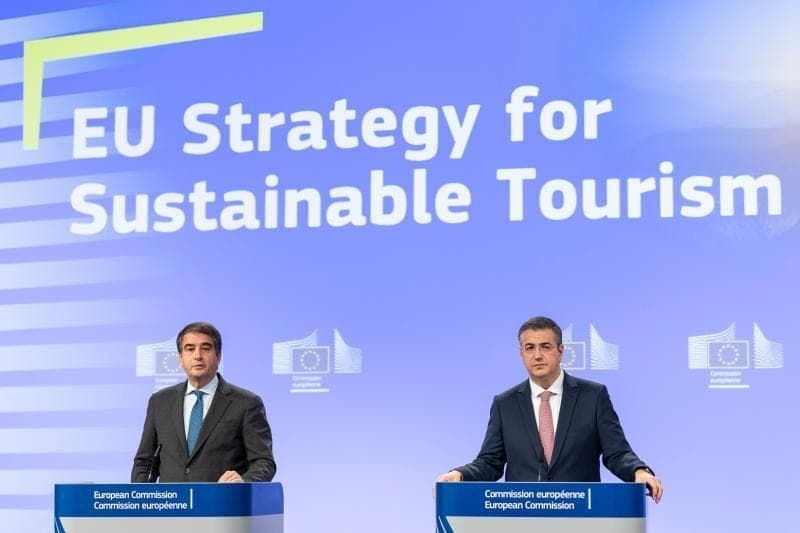
The European Union wants to take the lead in transforming its tourism offer.
With this first common strategy unveiled on 4 November, the European Commission aims to strengthen the sector’s competitiveness, reduce its environmental impact and improve economic returns for local areas.
Brussels is betting on support for SMEs, better management of tourist flows and a twin digital and green transition, underpinned by an action timetable running to 2034.
The document published by the Council of the European Union, the official transmission of the Commission’s Communication to the Council, sets out the main challenges facing tourism professionals.
Destinations above all lament a heavy concentration of activity in certain periods of the year. 42 per cent of European overnight stays are taken during the three busiest months.
This concentration, the European Commission notes, is placing growing pressure on housing, transport and water management in the most popular destinations.
The tourism sector must also work on its own digital footprint and cut waste, emissions and reliance on high‑carbon models.
According to Brussels, tourism in Europe must also contend with crises and geopolitical tensions that limit visibility on prospects, as well as recruitment difficulties.
According to the document, 92 per cent of SMEs report difficulties finding staff with the necessary skills.
An observatory, an academy and an alliance.
These SMEs are precisely the target of the Commission’s initiatives, which aim to cut their administrative burden, give access to data and technologies, finance their green transition and build their resilience.
By the end of 2026, a proposal to modernise VAT for travel and tourism will be tabled.
In 2027, an administrative simplification initiative will be launched alongside the creation of bodies to steer the transformation.
They include the European Tourism Observatory, building on the EU Tourism Dashboard, to produce and analyse data; the European Tourism Academy, to train professionals; and the European Tourism Alliance, to coordinate stakeholders and monitor implementation of the strategy.
The action programme will run until 2034 with tools for SMEs in the green transition and support for digitalisation.
Data as essential infrastructure.
Some of the challenges identified by the European authorities will be addressed through digitalisation and coordinated use of data.
The Commission therefore plans to roll out a common European tourism data space and to integrate tourism into EU initiatives on artificial intelligence.
“As AI agents play a growing role in discovery, recommendation and, tomorrow, booking, tourism distribution models will evolve,” said Mikael Quilfen on LinkedIn, a specialist in AI in travel and tourism and a consultant for Mindtrip.
“Beyond data sharing, the priority will be to enable European destinations, accommodation providers and operators to make their offers accessible and bookable through these new channels, while preserving their ability to create and capture value.”
The document also refers to other forms of this digitalisation drive, with pilots around the European digital identity wallets and support for travel‑tech start‑ups.
The Commission justifies the need to act by the sector’s considerable weight in the EU economies.
In 2025, Europe is estimated to have welcomed nearly 600 million international tourists, around 40 per cent of the global total.
Tourism directly accounts for 4.1 per cent of the Union’s value added, and up to 10.1 per cent including indirect and induced effects.
Tourism should no longer be seen as a peripheral activity but as a genuine economic and territorial pillar.
“Tourism is one of Europe’s main strategic economic assets. It is a driver of growth and innovation, creates millions of jobs and supports businesses and communities across Europe, with SMEs at the heart of the sector’s strength and competitiveness,” said Apostolos Tzitzikostas, European commissioner for sustainable transport and tourism.
“With the EU’s sustainable tourism strategy, we are giving tourism the recognition and place it deserves on the EU’s political agenda, while bringing businesses, destinations and public authorities together around a common vision to make European tourism more competitive, more sustainable and more resilient, ensuring that its benefits accrue to businesses, local communities and citizens across Europe.”
The European Commission has not yet set a single date for a first overall stocktake.
It nevertheless plans several milestones from 2027, notably the creation of the European Tourism Observatory, the European Tourism Alliance and the European network for crisis coordination.
The first edition of the Tourism Europe Days should also serve as an initial forum to review and discuss implementation of the strategy.