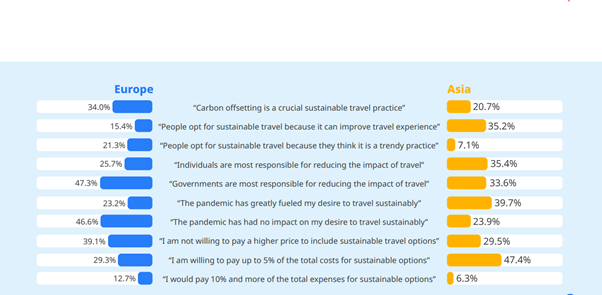
The vast majority of travel bookers in Asia and Europe would consider booking with OTAs that offer sustainable travel options, according to the results of a survey by Trip.com.
The Chinese online agent has released its first Sustainable Travel Consumer Report to coincide with this week’s World Tourism Day including the results of a survey of 7,705 people in 11 markets.
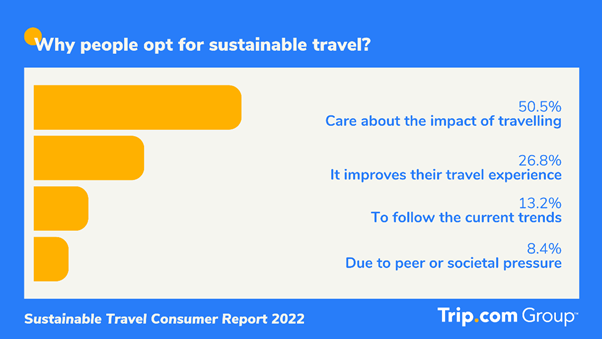
The study found 50.5% of those surveyed care about the impact of travel on future generations.
A third (26.8%) cited its role in improving the travel experience, while 13.2% perceived sustainable travel as ‘trendy’, and 8.4% admitted people opted for sustainable travel due to societal pressure.
The vast majority of respondents (93%) said they would consider booking via OTAs that provide sustainable options.
Meanwhile, only a fifth (20%) of respondents reported they don’t encounter any barriers to sustainable travel, while the rest said they come up against various obstacles.
“Inadequate visibility of sustainable options appears to pose a significant barrier to their wider adoption,” said Trip.com.
Travellers blamed this on the difficulty of accessing information about sustainable travel products, with over a third (32.9%) stating there is a lack of sustainable options and a quarter (25.4%) saying these are not clearly marked.
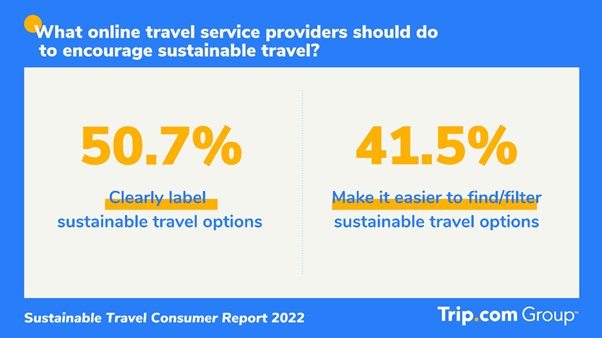
A little over half of them (50.7%) believed OTAs clearly label sustainable options while 41.5% who called upon OTAs to make it easier to find these options, and 39.4% suggested OTAs offer incentives.
Trip.com said this show that OTAs and booking platforms “have a significant opportunity to tap into this by showcasing their sustainable travel credentials and endearing themselves to like-minded users”.
Jane Sun, Trip.com group chief executive, said: "The results reaffirm our vision to educate travellers better and provide a greater volume and variety of reliable, sustainable travel options.
“Our findings are a clarion call to ourselves as to our allies in the travel sector. In the future, we will join hands with partners, travellers and other stakeholders to venture towards a more sustainable world."